
Introduction
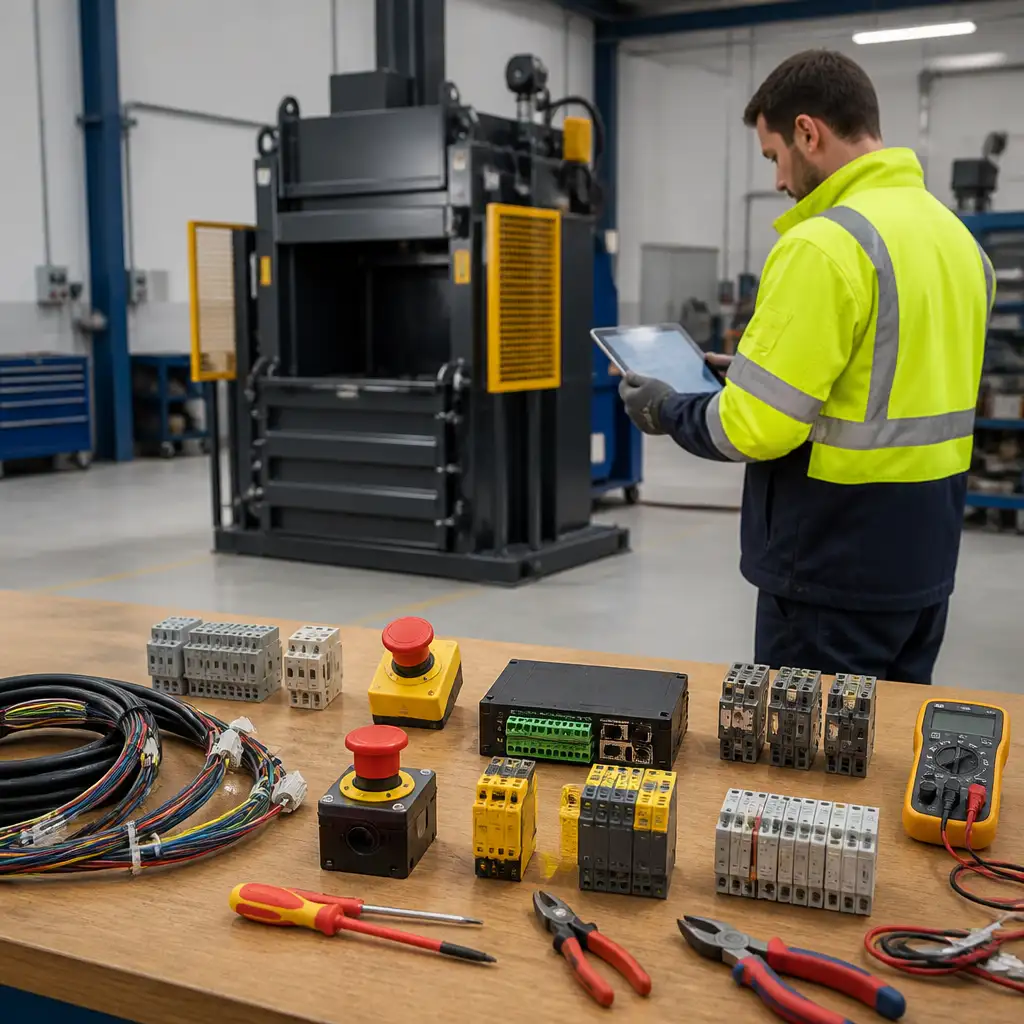
Older balers and compactors are common across Irish businesses — reliable machines that have served warehouses, retailers and recycling centres for years. When safety expectations evolve, facility managers face a choice: replace the machine or retrofit targeted safety measures. This article focuses on a cost-effective, practical retrofit checklist to bring legacy balers and compactors closer to accepted HSA practices without unnecessary replacement.
We explain what to check, how to prioritise interventions, and which improvements typically deliver the best safety return on investment. The guidance is practical and experience-based, drawn from servicing and repair work carried out nationwide in Ireland, and is not legal advice. For definitive requirements consult HSA guidance or a competent safety assessor.
Throughout the checklist we highlight common fixes — interlocks, guards, sensors, emergency stops, documentation and risk assessments — and point to useful next steps such as a machinery assessment or contact options for Europress retrofit components. The aim is to help you make informed, cost-conscious decisions that improve safety and extend machine life.
- Introduction
- Why choose retrofit over replacement?
- Understanding HSA expectations for balers and compactors
- Step 1: Initial machinery assessment and risk audit
- Step 2: Interlocks, guards and physical barriers
- Step 3: Sensors, controls and emergency stops
- Step 4: Documentation, labelling, training and ongoing maintenance
- Frequently Asked Questions
Why choose retrofit over replacement?
Replacement can be the right answer in some cases, but retrofit is often the more practical and economical route for machines that are structurally sound. Upgrading key safety systems extends operational life, reduces capital cost and minimises disruption. Baleforce Ireland’s approach — repair before replacement — is aimed at extracting long-term value while achieving acceptable safety outcomes.
Retrofitting also allows businesses to prioritise high-risk items first. Rather than a full capital purchase, targeted upgrades to interlocks, guarding and emergency stops can remedy the largest hazards quickly. This staged approach fits better with maintenance budgets and operational constraints in many Irish facilities.
Finally, a retrofit route preserves familiarity for operators and keeps downtime low when compared with removing and installing new equipment. Where new machinery is needed, options such as Europress equipment remain available; where retrofit suffices, focused upgrades and servicing provide an economical path to improved safety and reliability.
Understanding HSA expectations for balers and compactors
The Health and Safety Authority (HSA) expects employers to manage machine-related risks proportionately. For balers and compactors this typically means ensuring safeguards are in place to prevent access to hazardous parts, allowing safe isolation, and providing clear information and instruction to operators. Practical interpretation focuses on risk reduction rather than a one-size-fits-all checklist.
Common HSA-relevant practices include locking-off energy sources during maintenance, providing emergency stops that are easily reached, preventing access to moving parts with fixed guards or interlocked access panels, and maintaining clear records of risk assessments and training. These are sensible safety principles that can be achieved with retrofit measures in many cases.
Always treat the HSA guidance as the framework for action rather than prescriptive legal advice. A competent machinery assessment will translate those expectations into specific tasks for each machine based on condition, use pattern and site layout.
Step 1: Initial machinery assessment and risk audit
Begin with a thorough inspection and a documented risk assessment. Baleforce Ireland offers a free machinery assessment that identifies faults, inefficiencies and safety concerns. The assessment should record the machine serial, age, observed defects, and any previous repairs to give a complete picture of suitability for retrofit.
The risk audit should consider who uses the machine, typical faults, maintenance access, and the worst-case scenarios (e.g. entrapment during clearing). Prioritise hazards that could cause serious injury or repeated minor injuries — these are the interventions that usually justify retrofit first.
Use the assessment to produce an action list with estimated costs and a recommendation to repair, upgrade or replace. This evidence-based decision-making process aligns with Baleforce Ireland’s consultative, technical-first approach and helps managers balance safety, reliability and cost.
Step 2: Interlocks, guards and physical barriers
Physical guarding and interlocks are the first line of defence. Fixed guards prevent accidental contact with moving parts, while interlocked access panels ensure the machine stops or cannot cycle when a guard is opened. For many older machines, adding interlocks to existing access points can be a cost-effective way to meet reasonable HSA expectations.
Assess guard condition and fitment: loose or temporary guards should be replaced with robust, tamper-resistant versions. Where access is needed for maintenance, fit safety switches that force a controlled shut-down and isolation before any work can be done. Where practicable, use keyed or padlocked isolation points to prevent unauthorised restart.
Consider also the working environment — pinch points at feed areas, manual clearing zones and areas where operators might lean over equipment. Simple additions such as extended fixed bars, improved feed chutes or protective screens reduce exposure and are often inexpensive compared with full machine replacement.
Step 3: Sensors, controls and emergency stops
Modern sensors and control upgrades can add a substantial safety benefit to legacy machines. Presence-sensing devices, safety light curtains and pressure-sensitive edges can be integrated to stop or inhibit motion when a person enters a hazardous zone. Retrofitting a suitable control module is often a practical way to acceptably manage these risks.
Emergency stops must be well located, clearly identifiable by feel, and regularly tested. Where older machines have a single stop button in an inconvenient place, add additional E-stops to accessible positions and ensure they meet appropriate IP rating for the environment. A control upgrade can centralise stop monitoring and provide fault logging for maintenance teams.
Where upgrades touch electrical or control systems, use competent electrical technicians and conform to local wiring rules. Baleforce Ireland provides control upgrades and safety retrofits for Europress and other equipment; consult authorised sources for manufacturer-specific retrofit options when available to retain compatibility and parts support.
Step 4: Documentation, labelling, training and ongoing maintenance
Good documentation is a core part of meeting HSA expectations. Maintain up-to-date risk assessments, maintenance records, test certificates for interlocks and E-stops, and clear operating instructions. Labels that mark isolation points and safe operating zones reduce misuse and help during maintenance tasks.
Operator training is a low-cost, high-impact safety measure. Ensure staff understand safe procedures for feeding, clearing and isolating machines. Training should include recognition of faults and the process for reporting them. Practical on-site training reduces human error, which is a frequent contributor to incidents with older machinery.
Finally, put the retrofit into a maintenance programme. Regular checks on guards, interlocks, sensors and emergency stop functionality avoid drift in protective performance. Baleforce Ireland’s machinery service and repairs and maintenance contracts help maintain these systems and reduce the risk of future failures.
Frequently Asked Questions
Q: How do I know if my baler or compactor needs a retrofit or full replacement?
A: A competent machinery assessment is the best first step. Factors include structural condition, repair history, frequency of faults, and whether critical safety features can be cost-effectively upgraded. A free machinery assessment can help you decide.
Q: Can I add modern safety sensors to any older compactor or baler?
A: Many legacy machines can accept sensors and control upgrades, but suitability depends on space, control architecture and condition. Sensors should be installed and commissioned by competent technicians to ensure correct behaviour and reliable fault handling.
Q: Will retrofitting safety features meet HSA expectations on its own?
A: Retrofitting is a mitigation strategy; its acceptability depends on a documented risk assessment and correct implementation. Retrofitting combined with training, documentation and maintenance often meets practical HSA expectations, but seek expert assessment for certainty.
Not sure whether your equipment should be repaired, upgraded, or replaced? Baleforce Ireland offers honest, practical advice backed by over 20 years of industry experience. We focus on helping customers make informed decisions based on safety, reliability, and long-term value. Contact us at 087 458 0610 or info@baleforceireland.ie to discuss your options.