
Introduction
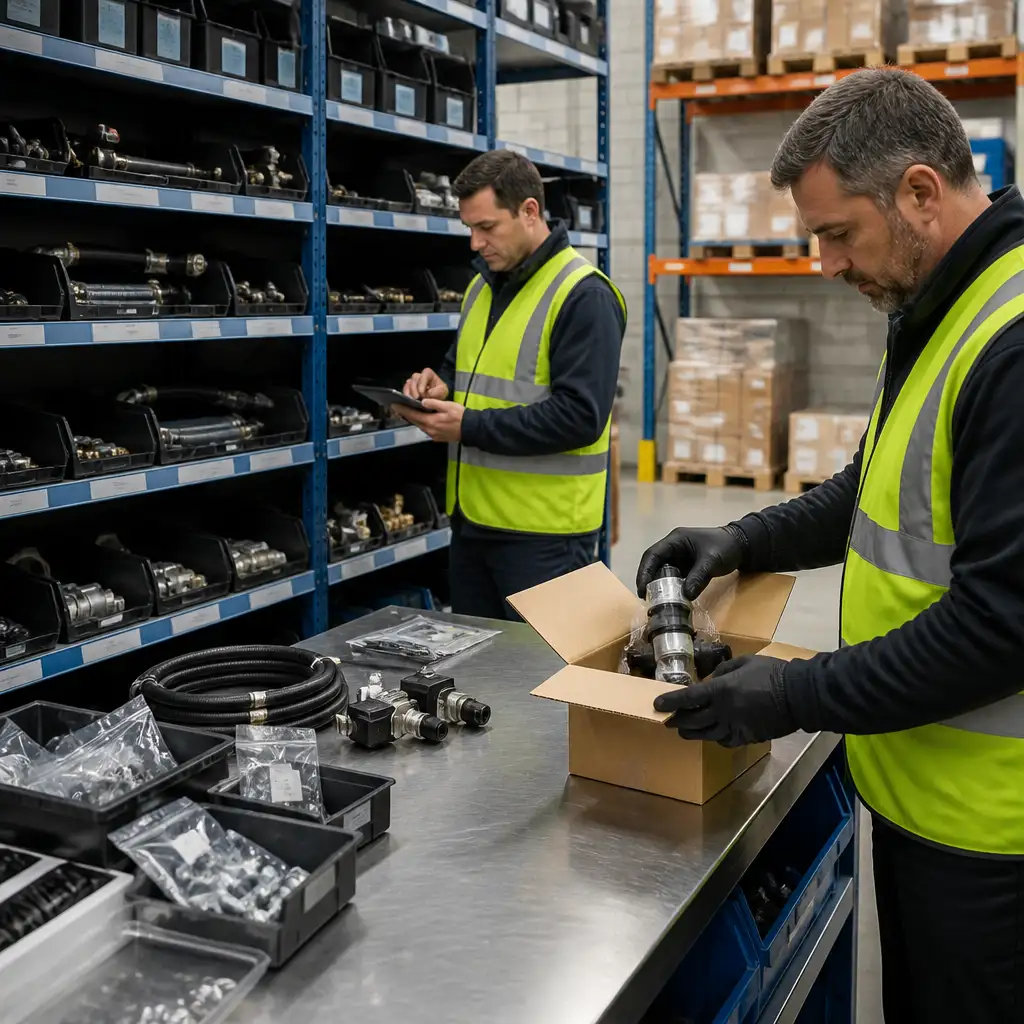
Reliable spare parts management is one of the simplest ways to reduce downtime and repair costs for balers and compactors. For facilities across Ireland, from retail centres to manufacturing sites, having the right spares in the right quantities keeps waste handling equipment moving and prevents small faults turning into full breakdowns.
This guide explains how to identify critical spares, set sensible stock levels, weigh genuine parts against aftermarket alternatives, and adopt parts identification and stock rotation practices that work in real-world operations. It draws on practical experience servicing balers and compactors nationwide and aims to help facilities managers, maintenance teams and procurement staff make better decisions.
Whether you operate a single compactor at a local hotel or a fleet of balers across multiple distribution centres, the recommendations here are designed to be pragmatic and cost-aware, while prioritising safety and long-term reliability.
- Introduction
- Identifying critical spares for balers and compactors
- Setting stock levels: a practical approach
- Sourcing parts: genuine versus aftermarket
- Tips for accurate parts identification
- Stock rotation and shelf-life best practice
- Parts prioritisation matrix
- Frequently asked questions
Identifying critical spares for balers and compactors
Begin by listing components whose failure causes immediate stoppage or safety risk. Typical critical spares include hydraulic hoses and seals, solenoid valves, pressure sensors, safety interlocks and motor starter components. Prioritise items that are single-point failures or commonly worn in your environment.
Use failure history and maintenance logs to refine your list. If a particular model of baler repeatedly suffers the same electrical fault, that specific relay or control module moves up the priority list. Baleforce Ireland recommends keeping a rolling three- to six-month review of breakdown causes to keep the critical list current.
Consider environmental and usage factors. Facilities with high throughput or abrasive waste streams (for example, recycling centres or manufacturing sites) will need more frequent replacement of wear items such as wear plates, guide rails and compaction blades compared with low-use sites.
Finally, include a small set of consumables that support rapid repair: hydraulic oil, filter elements, cable ties, sealing tape, and common fasteners. These help speed repairs and prevent multiple site visits when performing emergency work.
Setting stock levels: a practical approach
Stock levels should balance cost and risk. A useful starting point is categorising spares into three bands: critical (keep 1–3 on hand), necessary (keep 1 on hand), and optional (order when required). Adjust quantities based on mean time between failures (MTBF), lead times from suppliers, and the cost of downtime for your operation.
For sites in Leinster, where service response is typically faster, you might safely hold lower on-hand levels for non-critical items. For more remote Irish locations, increase local stock to avoid long waits for deliveries. Baleforce Ireland offers nationwide coverage with faster response in Leinster, which can influence stocking decisions.
Use a minimum/maximum reorder point system to trigger purchases automatically. Simple inventory cards or an electronic spreadsheet can be effective for smaller sites; larger operations should integrate spares into their CMMS. Regular reviews—quarterly or after any significant breakdown—ensure stock stays aligned with actual need.
Also factor in supplier lead times during peak periods (e.g. around bank holidays or busy recycling seasons) and consider strategic buffering for long-lead items such as control panels or custom hydraulic components.
Sourcing parts: genuine versus aftermarket
Choosing between genuine OEM parts and aftermarket alternatives is a common dilemma. Genuine parts generally offer guaranteed fitment, full compatibility, and direct manufacturer support — important for complex control systems or components affecting safety compliance. As an authorised Europress distributor, Baleforce Ireland can source genuine Europress parts for balers and compactors across the country.
Aftermarket parts can be a cost-effective option for non-safety-critical wear items where specifications are straightforward (for example, certain hydraulic hoses or fasteners). When using aftermarket suppliers, work with reputable vendors who provide material specifications, traceability and reasonable returns policies.
Assess risk by component type. For safety-critical items (interlocks, safety relays, pressure relief valves), the conservative choice is often genuine parts. For purely mechanical wear items, an approved aftermarket supplier may be acceptable, provided the parts meet the original specification.
Where uncertain, order a short-run of aftermarket parts for testing while keeping genuine parts on standby. If needed, Baleforce Ireland can advise whether a part should be genuine or if an aftermarket substitute is acceptable based on 20+ years of field experience.
Tips for accurate parts identification
Accurate identification prevents ordering wrong parts, which wastes time and money. Begin by recording machine make, model, serial number and the machine’s age. Many parts lists are specific to serial number ranges. Photograph the part in situ, labelled with the machine details and date, and keep that image in your maintenance record.
Use manufacturer diagrams, exploded parts lists and part numbers where available. If documentation is missing, remove the old part carefully and take multiple close-up photos showing mating faces, thread sizes, electrical connectors and mounting patterns. Baleforce Ireland offers parts identification assistance and can often identify obscure components from a good photograph.
Be precise about specifications: hose bore and pressure rating, hydraulic fitting types, electrical connector pin counts, and cable cross-section. For electrical components, note control voltages and part markings. Labelling replaced parts with a date and fitment note helps future identification and stock rotation.
Keep a local “parts master” file for each machine with common spares, part numbers, compatible alternatives and preferred suppliers. This reduces decision time during breakdowns and supports fast ordering for emergency repairs.
Stock rotation and shelf-life best practice
Some parts age in storage. Hydraulic seals, hoses and lubricants can degrade; electrical capacitors and batteries have finite shelf lives. Implement a first-in-first-out (FIFO) approach for consumables and perishable components to ensure older stock is used before newer stock.
Mark boxed or bagged items with purchase date and recommended use-by date when applicable. Store items in a clean, dry environment away from UV light and extreme temperature fluctuations. For hydraulic hoses, avoid tight bends during storage, and keep seals in sealed packaging until use.
Run periodic audits—quarterly is a good cadence for most facilities—to identify obsolete or expired parts. Remove and either dispose of or return unsuitable items and refresh reorder points based on usage patterns. This discipline minimises waste and the risk of fitting degraded parts during repairs.
For slow-moving expensive items, consider consignment stock or vendor-managed inventory arrangements. Baleforce Ireland can discuss parts support and inventory strategies tailored to your site and usage profile.
Parts prioritisation matrix
The following prioritisation matrix helps decide which parts to stock immediately, which to order on demand, and which to keep as traded spares across multiple sites. Use it alongside your failure history and operational criticality.
| Priority | Example parts | Stock level guidance | Rationale |
|---|---|---|---|
| High | Hydraulic hoses & seals, safety interlocks, motor starters, solenoid valves | 1–3 on hand | Immediate stoppage or safety risk; fast replacement reduces downtime |
| Medium | Sensors, pressure switches, control fuses, wear plates | 1 on hand | Failure affects performance; typically quick to fit but can halt production |
| Low | Specialised electrical modules, large hydraulic cylinders, custom panels | Order when required; consider pooled stock for multi-site groups | High cost or long lead time; downtime cost may justify strategic stocking |
For multi-site organisations, centralising slow-moving high-cost parts at a regional hub and keeping critical, fast-moving spares on-site balances cost and responsiveness. Use the matrix to build a site-specific spares policy and review it after every major incident.
Frequently asked questions
Q: How many spare hydraulic hoses should a medium-sized retail site keep on hand?
A: A typical medium retail site should keep at least one full set of common hydraulic hoses and a set of seals for their baler/compactor, plus a spare solenoid valve if the model is known to fail. Adjust quantities based on past failures and supplier lead times.
Q: Can aftermarket parts void warranties or affect compliance?
A: Using aftermarket parts can affect warranty terms with some manufacturers, and for safety-critical components it may impact compliance. Always check the manufacturer’s guidance and consider genuine parts for safety-related items.
Q: When should we request an equipment assessment to plan spares strategy?
A: Arrange a free machinery assessment whenever you change waste streams, add equipment, experience repeated faults, or before a major peak season. A professional assessment helps align spares to actual risk and usage patterns. You can book a free machinery assessment with Baleforce Ireland for tailored advice.
Need support with waste handling equipment anywhere in Ireland? Baleforce Ireland provides nationwide service, repairs, machinery assessments, upgrades, operator training, and technical support, with faster response times throughout Leinster. Call 087 458 0610 or email info@baleforceireland.ie to get started.