
Introduction
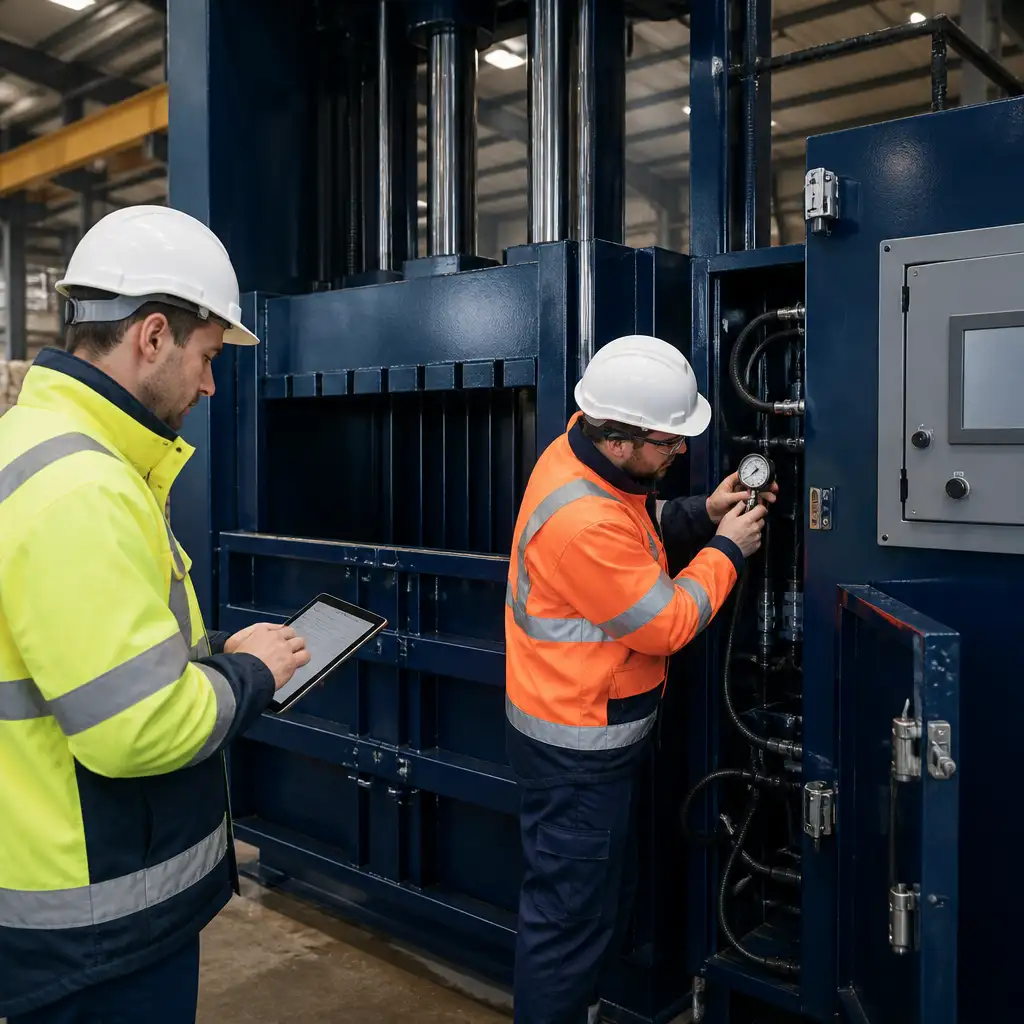
Recurrent baler breakdowns are an expensive and frustrating problem for many Irish facilities. Repeated call-outs disrupt waste handling, increase costs, and can create safety risks for staff. A structured root cause analysis (RCA) helps teams move beyond symptom-fixing and implement lasting repairs that reduce repeat failures and downtime.
This guide explains a practical RCA method tailored specifically to balers, covering mechanical, hydraulic and electrical faults. It is written for facilities managers, maintenance technicians and operators who need clear, actionable steps they can apply on site in Ireland, whether the baler is a Europress unit supplied by Baleforce Ireland or a third-party machine.
We will walk through preparation, diagnostic checklists, evidence recording (including a sample fault log), analysis techniques, implementing corrective actions, and monitoring outcomes. The aim is to help you deliver safer, more reliable baler operation and reduce the frequency of baler repairs Ireland teams need to request.
- Introduction
- Why carry out an RCA for baler breakdowns?
- Preparing for the investigation
- Diagnostic checklist: mechanical, hydraulic and electrical
- Collecting and documenting evidence (sample fault log)
- Analysing data and identifying root causes
- Implementing lasting repairs and corrective actions
- Frequently Asked Questions
Why carry out an RCA for baler breakdowns?
Reactive repairs fix the immediate problem but rarely prevent recurrence. An RCA identifies underlying issues — for example, a misaligned platen that repeatedly damages seals or an intermittent sensor fault that leads to unsafe cycling. By addressing root causes you reduce repeat call-outs and lower total cost of ownership.
An effective RCA improves safety and compliance. Some faults are early warning signs of larger safety risks: worn interlocks, deteriorating safety mats, or degraded hydraulic hoses. Identifying these before a serious incident protects staff and helps demonstrate due diligence to auditors and insurers.
For organisations across Ireland, a robust RCA also supports long-term planning. Findings feed into maintenance schedules, operator training and budget forecasts. Where a repair is impractical, the RCA provides documented justification for upgrade or replacement decisions.
Preparing for the investigation
Begin with safety. Isolate the baler electrically and hydraulically and follow lock-out/tag-out procedures. Only authorised personnel with the correct PPE and training should work on the machine. Make sure any safety systems required by legislation are restored and recorded after testing.
Gather people and information. Include the operator, in-house maintenance staff and, if needed, an external technician. Collect historical maintenance records, recent service reports, operator notes and any previous fault logs. If you’re unsure about complexity, consider arranging a free machinery assessment to get an independent evaluation.
Prepare tools and test equipment: multimeter, clamp meter, hydraulic pressure gauge, infrared thermometer, camera for photos, torque wrench, and a notepad or tablet for recording observations. Clear the work area so you can observe the machine running if safe to do so, and plan for an orderly return to service once the investigation is complete.
Diagnostic checklist: mechanical, hydraulic and electrical
Use a structured checklist to ensure consistent diagnostics. Start with mechanical items: check platen alignment, wear on guides and bushings, drive belts, bearings and fasteners. Look for signs of metal fatigue, unusual wear patterns, missing lubrication or foreign objects jammed in the compression chamber.
Hydraulic checks are often where baler reliability hinges. Inspect hoses and fittings for abrasion, leaks or bulging. Verify hydraulic oil level and contamination—water, darkening or metallic particles indicate problems. Measure system pressure at idle and under load with a pressure gauge, and compare readings to the manufacturer’s specifications.
Electrical faults can be intermittent and require careful observation. Check control panel indicators, error codes, wiring harnesses, connectors and earthing. Measure voltages at key points, test limit switches and sensors for correct operation, and review PLC or controller fault histories. If necessary, record transient errors during a test cycle with a portable data logger.
Collecting and documenting evidence (sample fault log)
Accurate documentation makes the RCA usable and repeatable. Create a fault log that records date, time, operator, symptom, environmental conditions, and immediate remedial actions. Photos and short videos are particularly valuable for visual faults — for example, a squeezing platen visibly misaligned under load.
Below is a simple sample fault log you can adapt for your facility. Keep one copy electronically and one attached to the machine until the issue is resolved and verified.
| Date | Time | Operator | Symptom | Immediate Action | Notes / Measurements |
|---|---|---|---|---|---|
| 2026-03-12 | 09:15 | J. O’Connor | Platen stalls mid-cycle; audible hissing | Stopped machine, isolated hydraulics | Hydraulic pressure at 60 bar (spec 120 bar). Visible oil leak at hose A. |
| 2026-03-14 | 10:45 | M. Byrne | Control panel fault E13 intermittently | Recorded fault code; ran diagnostic cycle | Loose connector at P2. Re-seated; fault returned twice during load. |
Attach supporting documents: recent maintenance invoices, oil analysis reports, sensor test logs and any external service reports. These documents help correlate patterns and show whether a repair fixed the symptom or the cause.
Analysing data and identifying root causes
Move from symptoms to causes using structured techniques. The 5 Whys is a simple starting point: ask why a failure occurred and repeat five times until you reach the underlying reason. For more complex issues, a fishbone (Ishikawa) diagram helps group potential causes into categories such as Materials, Methods, Machine, Man, Measurement and Environment.
Analyse trends across fault logs. Are failures clustered around shifts, loads, or environmental conditions? For example, if electrical faults coincide with wet weather, ingress or poor sealing may be the root cause. If hydraulic failures follow heavy-duty shifts, overheating or contamination could be implicated.
Triangulate findings with measurements and expert input. A dropped system pressure combined with a worn pump and a degraded return filter suggests contamination or pump wear as the root cause. Where uncertainty remains, plan targeted tests or temporary mitigations to confirm hypotheses without causing further damage.
Implementing lasting repairs and corrective actions
Design corrective actions that eliminate root causes, not just symptoms. If contamination caused hydraulic failure, replace the pump and hoses and perform a full fluid flush plus filtration upgrade. If intermittent electrical faults stem from vibration-loosened connectors, install secure locking connectors and add strain reliefs.
Prioritise actions by safety and downtime impact. Immediate safety hazards should be corrected before production-returning measures. Document every corrective action with date, personnel, parts used, and verification tests. This record is critical for future audits and for assessing whether the repair eliminated the root cause.
If repairs are beyond in-house capability, arrange professional support. Baleforce Ireland provides field service and can assist with complex fault diagnosis or emergency work; for urgent situations use the breakdown and emergency repairs page to request rapid response. Where the RCA shows repeated failures on older equipment, a documented assessment can inform decisions about upgrades, retrofits or replacement with new or used and refurbished machinery.
Frequently Asked Questions
Q: How long does a typical RCA take on a baler?
A: A straightforward RCA for a single recurring fault can take a day; more complex or intermittent issues may require several days of monitoring and testing to gather definitive evidence.
Q: Will an RCA always show whether to repair or replace a baler?
A: An RCA reveals underlying causes and helps make an informed decision. If repair restores reliability and safety, repair is usually preferred; if repeated root causes point to ageing or poor design, replacement may be recommended.
Q: Can Baleforce Ireland help with on-site RCA and follow-up repairs?
A: Yes. Baleforce Ireland offers expert fault diagnosis, servicing and practical repair recommendations across Ireland and can carry out repairs or provide a machinery assessment to support your decision-making.
Not sure whether your equipment should be repaired, upgraded, or replaced? Baleforce Ireland offers honest, practical advice backed by over 20 years of industry experience. We focus on helping customers make informed decisions based on safety, reliability, and long-term value. Contact us at 087 458 0610 or info@baleforceireland.ie to discuss your options.