
Introduction
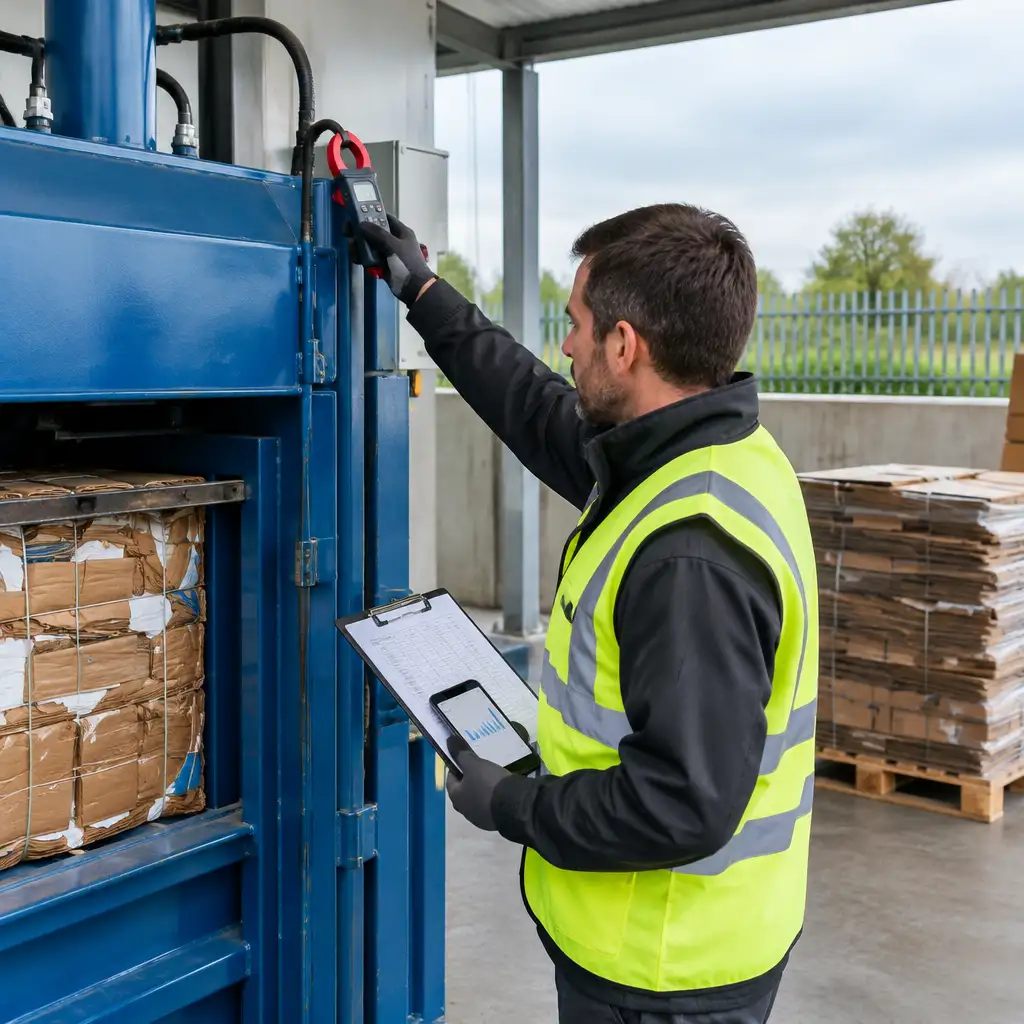
Unexpected baler and compactor breakdowns cost Irish SMEs time, money and customer trust. Simple, low-cost predictive checks using basic data logging and manual trending let you spot developing faults — hydraulic leaks, motor overloads, worn seals or control faults — before they become emergency call-outs. This practical guide explains how small teams can put a straightforward programme in place with inexpensive sensors, easy spreadsheet templates and sensible thresholds for when to call a technician.
We will focus on baler predictive maintenance Ireland operators can implement today without major capital investment. The approach is deliberately pragmatic: combine visual inspections and operator notes with measured values such as power draw, cycle times and hydraulic pressures. These few metrics often reveal early signs of deterioration long before a machine stops working.
The remainder of this article covers what to log and why, examples of low-cost sensors and tools, simple spreadsheet templates you can use, recommended trigger thresholds for technician call-outs, and practical tips for implementing a routine that fits busy operations. Throughout we reference appropriate Baleforce services to help where professional support is needed.
- Introduction
- Why predictive logging matters for small businesses
- What to log and why: power, cycle time and pressure
- Low-cost sensors and tools that work
- Simple spreadsheet logging templates
- Recommended trigger thresholds and when to call a technician
- Implementing a routine that staff will keep
- Frequently asked questions
Why predictive logging matters for small businesses
For many Irish SMEs operating balers and compactors — retail outlets, warehouses, catering centres and small manufacturers — downtime has an outsized cost. An unplanned baler failure can halt waste throughput, create health and safety issues and trigger expensive same-day repairs. Predictive logging turns reactive maintenance into planned maintenance: you act when data shows a trend, not when the machine is already down.
Predictive checks are especially appropriate where a full condition-monitoring system would be too costly. Manual or semi-automated logging targets a small set of meaningful indicators. That focused approach is easier to maintain and still captures the majority of common fault patterns: increasing motor current, longer cycle times, fluctuating hydraulic pressures and repeated error codes.
Used consistently, these checks give you early warning and the data to support repair decisions. That supports Baleforce Ireland’s core principle: repair before replacement. If you prefer professional assistance to interpret trends or carry out repairs, our machinery service and repairs team can assist nationwide, with faster response in Leinster.
What to log and why: power, cycle time and pressure
This section outlines three primary measurements that offer high signal-to-noise for early fault detection: electrical power draw (or motor current), cycle time, and hydraulic pressure. Each shows different failure modes.
Power draw / motor current: A rising steady-state current suggests increased mechanical friction (worn bearings, jammed feed paths) or hydraulic inefficiency. Spikes or intermittent surges often indicate electrical issues or motor control faults. Recording peak and average current during representative cycles gives you a simple trend to monitor.
Cycle time: Measure from cycle start to cycle end for a typical load. Slower cycles can indicate hydraulic slip, worn valves, changes in oil condition or partial blockages. A consistent increase over days or weeks is a reliable early sign of mechanical deterioration.
Hydraulic pressure: Record system pressure at working and idle points. Falling maximum pressure may indicate pump wear or relief valve drift; unstable pressure can point to leaks, air ingress or failing accumulator components. These readings pair well with visual checks for fluid level and contamination.
Low-cost sensors and tools that work
You do not need to buy an industrial condition-monitoring system to start useful predictive checks. Below are practical, affordable options commonly used by SMEs.
For electrical measurements: a clamp-on digital current meter (split-core ammeter) from a reputable supplier will record RMS current without interrupting the supply. Many models offer data logging or Bluetooth output and cost from €50–€200 depending on features. For simple setups a handheld meter used weekly is sufficient; for automated trending choose a logger with USB export or Bluetooth to a smartphone.
For cycle time: use a stopwatch or a small event logger. Many operators use a smartphone stopwatch or a simple push-button event logger (counts start/stop events and timestamps them). For automated solutions, low-cost IoT counters can detect start and finish signals from existing machine controls and send timestamps to a cloud spreadsheet.
For hydraulic pressure: a mechanical gauge is cheap and useful for spot checks. For logging, low-cost 0–250 bar digital pressure sensors with 4–20 mA or 0–10 V output can be connected to a basic data logger or a Raspberry Pi/Arduino-based logger for a modest cost. Always ensure pressure sensors match the system range and are fitted per manufacturer safety guidance.
Other useful, inexpensive items: infrared thermometer for motor housing temperature checks, a visual leak detection dye for hydraulic systems, and a simple logbook or clipboard mounted next to the machine to encourage regular entries. Remember to follow safety rules when taking measurements and isolate power when fitting sensors that require electrical connections.
Simple spreadsheet logging templates
A consistent, easy-to-read spreadsheet is the heart of manual trending. Create a single sheet per machine with columns for date, operator, batch type (heavy/standard), power draw (A), cycle time (s), max hydraulic pressure (bar), oil level, and remarks. Here is a minimal example you can replicate in Excel or Google Sheets:
| Date | Operator | Batch type | Avg current (A) | Peak current (A) | Cycle time (s) | Max pressure (bar) | Oil level/condition | Remarks |
| 2026-03-01 | Mary | Standard | 12.5 | 15.8 | 35 | 150 | OK | No issues |
Use simple formulas to calculate a 7-day moving average for each numeric column. A chart plotting the moving average makes trends obvious at a glance. If you use Google Sheets you can allow remote access to your service provider for quick review.
Store historic exports monthly and keep a simple folder with printouts or PDFs. When an operator notes a change, line up the dates with production records to rule out process changes (different material, heavier loads) before assuming a fault.
Recommended trigger thresholds and when to call a technician
Trigger thresholds should be conservative enough to reduce false alarms but sensitive enough to catch problems early. Below are practical starting points; adjust them based on your machine’s normal variation and the manufacturer’s guidance.
- Electrical current: If the 7-day moving average of average current increases by >15–20% from baseline, log a review. A sustained increase >25% should prompt a technician visit.
- Peak current spikes: Repeated peak events exceeding 30% above normal peak values warrant immediate investigation; they often precede motor starter or control faults.
- Cycle time: If average cycle time rises by 15% and does not correlate with a change in material type, schedule an inspection. A 25% increase should trigger a technician call.
- Hydraulic pressure: A drop in working pressure greater than 10–15% or pressure that fluctuates by more than 10% during a cycle suggests pump or valve problems; call for a review.
- Fluid condition/leaks: Any visible oil contamination, foam, or repeated top-ups beyond normal consumption requires prompt attention.
When thresholds are hit, use a checklist to capture the context: recent change in material, operator notes, ambient temperature, and any logged alarms. If the checklist does not explain the trend, arrange a service visit. For help with fault diagnosis or urgent issues you can contact Baleforce Ireland’s machinery service and repairs team or request a free machinery assessment to confirm next steps.
Implementing a routine that staff will keep
The best system is the one your team will use. Keep the routine short, integrate measurements into normal workflows, and make responsibilities clear. A typical programme for SMEs might include a daily visual check and weekly logged measurements, with monthly spreadsheet review by a supervisor.
Assign responsibilities: operators do daily visual checks and note cycle times and obvious anomalies; a nominated person (shift lead or facilities staff) compiles a weekly log and updates the spreadsheet. Use short training sessions to show staff how to take measurements safely and how to enter data. Keep instructions laminated by the machine so they are easy to follow.
Make escalation simple. Define a two-tier response: if measurements exceed advisory thresholds, log and recheck within 24–48 hours; if measurements exceed alarm thresholds, call for technician support. Keep contact details for emergency support and for scheduled servicing handy — Baleforce Ireland offers nationwide support and fast response in Leinster for emergency and planned work.
Finally, review logs quarterly to decide whether a maintenance contract or an upgrade would reduce downtime and cost. Small investments in seals, filters and routine adjustments often pay back quickly by preventing bigger failures.
Frequently asked questions
Q: How quickly will I see useful trends from manual logging?
A: You can see meaningful trends within two to four weeks for cycle time and current; hydraulic trends sometimes take longer. Consistent weekly logs and a 7-day moving average make trends visible quickly.
Q: Can I use smartphone apps for logging instead of spreadsheets?
A: Yes. Smartphone timers and cloud spreadsheets (Google Sheets) work well for small setups. Choose what your team will use reliably. For automated alerts or large fleets, consider a more formal data-logging solution.
Q: When should I stop trying to diagnose and call a technician?
A: Call a technician if alarm thresholds (current increase >25%, cycle time increase >25%, significant pressure loss or visible fluid contamination) are met, if you see recurring error codes, or if safety systems are affected. For professional diagnostics and repairs, Baleforce Ireland provides breakdown and planned support across Ireland.
Need support with waste handling equipment anywhere in Ireland? Baleforce Ireland provides nationwide service, repairs, machinery assessments, upgrades, operator training, and technical support, with faster response times throughout Leinster. Call 087 458 0610 or email info@baleforceireland.ie to get started.