
Introduction
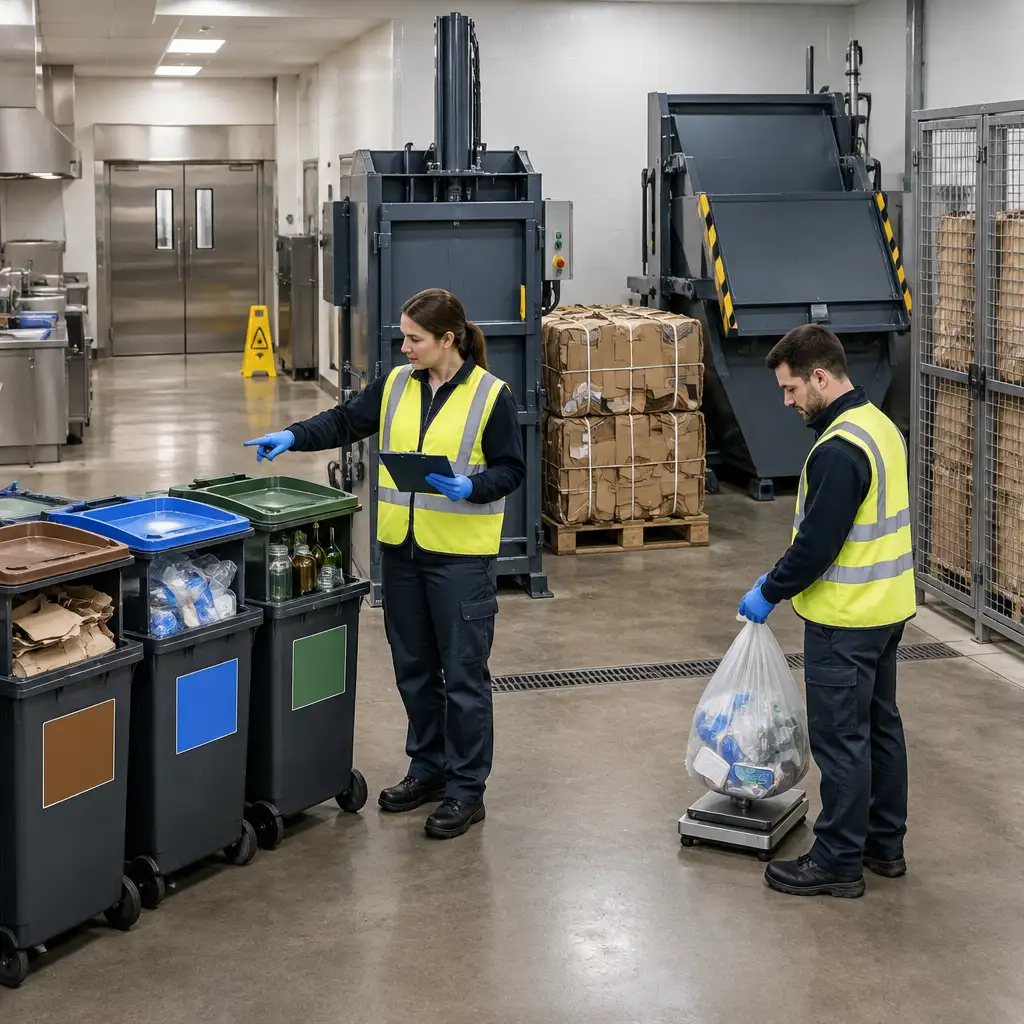
Facilities managers in Irish retail and hospitality face tight margins, limited back-of-house space and complex waste mixes. An on-site waste stream audit helps you make practical, evidence-based choices about balers and compactors that reduce costs, lower servicing needs and improve recycling rates. This guide explains how to carry out a hands-on audit, convert findings into equipment throughput figures, and choose configurations suited to retail shops, cafés, pubs and hotels across Ireland.
We focus on real-world steps: what to measure, who to involve, simple throughput calculations and a decision framework for choosing a baler, a compactor or a mixed solution. The advice reflects a service-first approach: repair before replacement, safety and long-term value for your organisation.
Read on for checklist items, sample calculations for common material streams (cardboard, plastic film, glass), and guidance to reduce maintenance and unexpected breakdowns. Links to practical equipment resources and a free assessment option are included for readers ready to act.
- Introduction
- Why carry out an on-site waste stream audit?
- Preparing for the audit: team, safety and tools
- Conducting the audit: sampling, counting and throughput
- Baler vs compactor: a practical decision framework
- Sizing equipment and typical configurations for retail & hospitality
- How to reduce servicing needs and lifecycle costs
- Frequently asked questions
Why carry out an on-site waste stream audit?
An on-site audit shows the real composition and volume of waste produced by your site, rather than relying on supplier estimates or generic benchmarks. For retail and hospitality this matters because material mix is highly variable: a supermarket depot will produce very different streams to a city-centre hotel or a busy pub. Understanding your mix lets you specify equipment that matches throughput and material type, avoiding overspecification or machines that require excessive maintenance.
The audit provides measurable data to reduce disposal costs and increase recycling revenue where appropriate. For example, baling dry cardboard and film reduces collection frequency and transport costs; compacting residual waste reduces bin swaps and labour. Decisions based on audit data typically pay for themselves within a short period through lower handling and servicing costs.
Finally, an audit highlights safety and operational issues that affect uptime. Identifying pinch points, unauthorised waste streams or poor segregation can prevent damage to machinery and reduce the need for emergency repairs. A documented audit also supports discussions with waste contractors and helps qualify a case for investment or upgrade.
Preparing for the audit: team, safety and tools
Successful audits need a small team and simple tools. Typical participants are a facilities manager, a shift supervisor or duty manager, a member of the housekeeping or bin team and, where available, a service technician. Involve operational staff early so recommendations will be practical and followed. If you prefer, request a free machinery assessment to combine an equipment inspection with the audit.
Safety is paramount. Ensure everyone has appropriate PPE (gloves, hi-vis, safety footwear) and that audits avoid peak service periods to lower risk. Lock out any nearby machinery and keep clear segregation areas. Note any safety concerns during the audit—damaged skip lids, blocked compactor chutes or missing guards—and treat these as immediate actions.
Essential audit tools are simple: clipboards, tally counters, sample bags, digital scales, a tape measure and a camera (no visible text or logos on photos). Use a simple spreadsheet to record counts by stream, sample weights and collection frequencies. Record the time taken to move waste, distances to external collection points and height/door constraints that affect equipment installation.
Conducting the audit: sampling, counting and throughput
Choose a representative audit period—ideally a full week capturing weekday and weekend activity for hospitality, or a typical trading week for retail. If a full week isn’t possible, use sampling across different shifts and days to capture variation. Record the number of bags, bins or cages for each waste stream and take random weight samples to calculate average mass per container.
Convert counts and sample weights into daily and weekly tonnages. Example: if the back-of-house produces on average 20 small cardboard flatpacks per day and a 10-sample average weight is 2.5 kg per flatpack, daily cardboard = 20 × 2.5 kg = 50 kg/day. Weekly cardboard = 350 kg. If you compact or bale, use compression ratios to estimate final bale or compacted volume.
Sample throughput calculation for a small hotel producing cardboard and film:
- Average cardboard per day: 50 kg (as above)
- Average plastic film per day (stretch wrap from deliveries): 10 kg
- Weekly cardboard: 350 kg, plastic film: 70 kg
- Cardboard bale weight target: 100–150 kg for easy handling — so expect 3–4 bales per week
- Film can either be baled with a small horizontal baler or collected in a 240-litre sack for recycling — throughput suggests a small baler or consolidated weekly collection
These figures inform whether a light-duty baler or a compactor is appropriate and how often bales need collecting.
Baler vs compactor: a practical decision framework
Start with material type. Balers are best for dry, recyclable materials: cardboard, paper, clear plastic and some films. Compactors are designed to reduce the volume of mixed residual waste and can be the right choice where space is limited and waste includes high-moisture or food-related streams common in hospitality.
Consider throughput and handling. If your weekly recyclable cardboard exceeds about 200–300 kg and can be segregated, a baler will reduce collection frequency and transport costs. For sites producing several hundred litres of residual waste per day with low recyclable volumes, a compactor can lower labour and bin lift frequency. Mixed solutions are common: a small baler for cardboard and a compactor for residuals.
Practical constraints also matter. Balers require an area to store finished bales safely; check ceiling heights and door widths for bale movement. Compactors need an external collection point and may require pit work or dedicated bays. Where installation is constrained, consider compact or vertical balers or a rental compactor as a temporary solution. Baleforce Ireland provide independent advice and can point you to appropriate equipment solutions and Europress models that suit your site.
Sizing equipment and typical configurations for retail & hospitality
Sizing is a balance of daily throughput, future growth and available space. Use your audit data to estimate monthly tonnage by stream, then match that to machine cycle times and recommended bale or ram sizes. For retail, typical configurations include a small vertical baler for cardboard and a compactor for residuals. For hospitality, a fixed or bin-lift compactor for food waste and a horizontal baler for bottles and glass in larger venues may be appropriate.
Sample sizing checklist for a medium-sized supermarket back-of-house:
- Average cardboard: 1,200 kg/week → recommend a medium-duty vertical baler producing 200–300 kg bales, collection twice per week.
- Plastic film: 200 kg/week → small horizontal baler or film compactor module.
- Residual waste: 6,000 litres/day → a 3–6 m3 compactor with daily or alternate-day collection.
Use the bale weight and compactor fill rates to choose collection frequency and storage needs.
Space and handling: ensure access for removal of bales and service engineers. If on a tight urban site, consider a low-profile compactor or hire options. For many businesses, refurbished equipment is a cost-effective route; Baleforce supply used and refurbished machinery as well as new Europress balers and compactors. If you are unsure which route to take, a machinery assessment will clarify whether repair, upgrade or replacement is the best option.
How to reduce servicing needs and lifecycle costs
Reducing servicing needs starts with correct specification and good operation. Choose a machine with the right duty rating for your throughput—an undersized baler will be overworked and demand frequent repairs. Implement basic operator training to reduce misuse (a key cause of faults) and keep a simple log of hours run, faults and preventive tasks. Operator training is an inexpensive way to extend equipment life and improve safety.
Preventative maintenance is more cost-effective than waiting for breakdowns. Regular checks on hydraulics, seals, sensors and control panels detect wear before failure. Baleforce Ireland specialise in machinery service and repairs and offer preventative maintenance programmes that lower long-term costs. Repair-before-replacement remains the default: fix what is practical, upgrade controls or safety systems when beneficial, and only replace where a full lifecycle analysis supports it.
Operational tips to reduce costs:
- Segregate dry recyclables to avoid contamination of bales.
- Store bales undercover to prevent wetting and extra weight.
- Keep a planned spare-parts list and an emergency contact for rapid response; faster response across Leinster is a practical advantage for many clients.
These measures reduce emergency call-outs and make servicing predictable and affordable.
Frequently asked questions
Q: How often should I have baler servicing carried out to avoid breakdowns?
A: Servicing frequency depends on duty cycle. For medium to high use sites, a quarterly inspection plus a detailed annual service is common. Lower-use sites may manage with biannual visits. Preventative contracts reduce unexpected repairs and overall cost.
Q: Can a small hospitality site use a baler and still maintain hygiene standards?
A: Yes. Choose a baler suited to dry streams (cardboard, clean plastics) and keep it in a well-ventilated, clean area. Implement cleaning protocols and train staff to avoid putting wet food waste into balers.
Q: What is the best next step after an on-site audit?
A: Use the audit to request a site-specific recommendation. A free machinery assessment will identify any safety concerns, confirm capacity requirements and suggest repair, upgrade or replacement options tailored to your site.
Need support with waste handling equipment anywhere in Ireland? Baleforce Ireland provides nationwide service, repairs, machinery assessments, upgrades, operator training, and technical support, with faster response times throughout Leinster. Call 087 458 0610 or email info@baleforceireland.ie to get started.