
Introduction
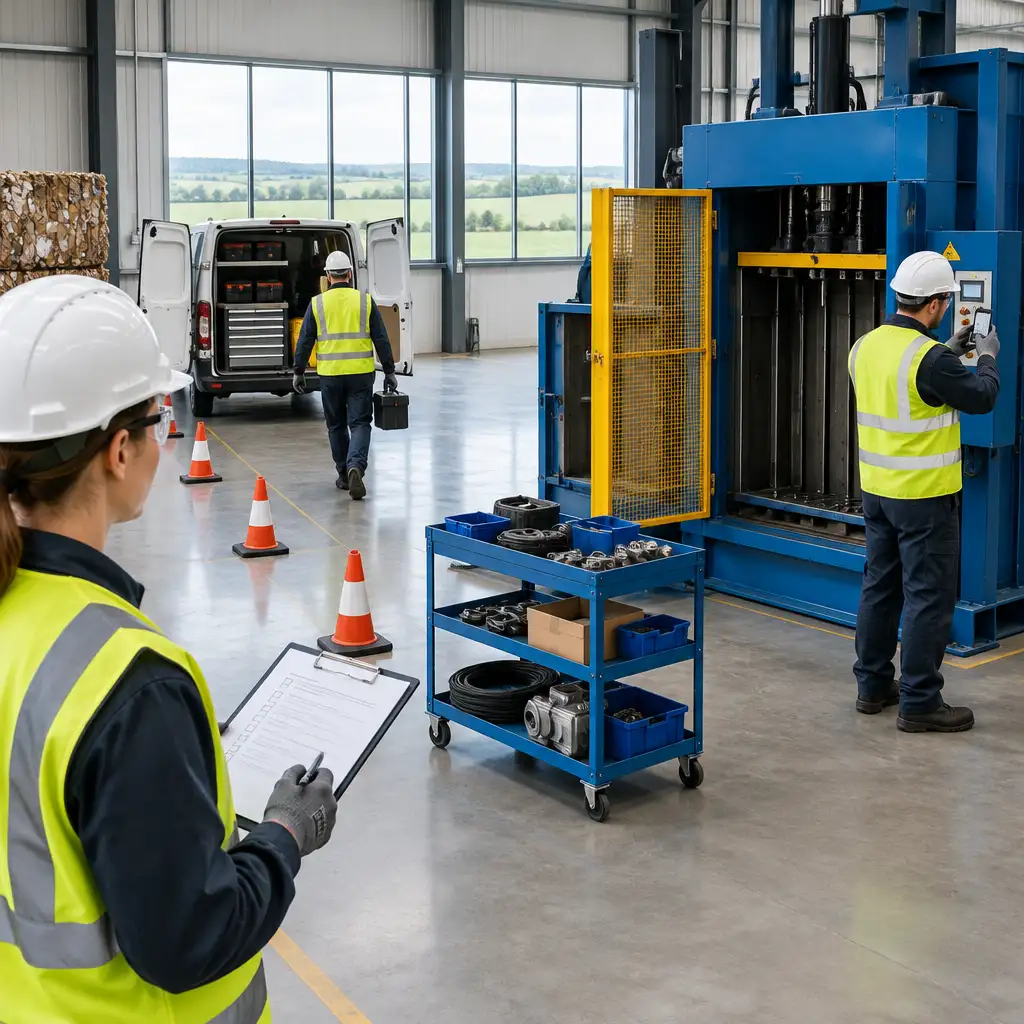
When a baler or compactor fails it affects waste flows, staff routines and operational costs. Technicians can diagnose and repair faults far more quickly if site teams prepare key information and make the machine accessible before the service visit. This article explains a practical site-preparation checklist designed to reduce technician time on-site and cut downtime and call-out costs.
Although the guidance here applies across Ireland, we highlight the benefit of faster response times in Leinster where Baleforce Ireland typically reaches customers within 24 hours. Preparing your site means our technicians spend less time on access, paperwork and searches — and more time fixing faults and returning equipment to safe, reliable service.
We’ll cover access and layout, isolation points and safety, what machine history to gather, recommended spare parts and tools, useful photos to take, and best practice for operator contacts. A ready-to-use checklist template is included so site managers can implement a consistent process across shifts and sites.
- Introduction
- Why prepare your site for repairs
- Access and layout: make the machine reachable
- Isolation points and safety information
- Machine history and documentation to gather
- Spare parts and tools to have ready
- Photos, photos, photos — and operator contacts
- Frequently asked questions
Why prepare your site for repairs
Technician time is billable and the quicker a fault is isolated and repaired the lower the overall cost to the business. Practical site preparation reduces the non-technical tasks a technician must undertake on arrival, such as locating isolation points, searching for parts, or waiting for operator information.
Prepared sites also improve safety. When technicians can quickly find lock-off points, PPE, and clear access routes, they avoid delays that create rushed work or unsafe shortcuts. That matters both for compliance and for protecting staff and service teams.
From a service-provider perspective, prepared sites let technicians focus on diagnosis and repair rather than administration. This is especially valuable when we are providing emergency support or scheduled baler servicing: Ireland-wide coverage is available, and Leinster customers benefit from our faster response times.
Access and layout: make the machine reachable
Clear, predictable access is the first practical step. Remove obstructions from around the machine, create a safe pedestrian route, and ensure there is space for a service van or lifting gear if the job might need it. Mark or inform staff of the parking location for the visiting technician to avoid delays on arrival.
Check that doors and hatches open easily and that there’s adequate lighting. If the machine is inside a locked area, provide a named point of contact and an agreed time window for the visit. For sites with multiple machines, a simple site map showing each machine’s location saves time.
Where machine positioning could hinder lifting or component removal, identify alternative access points in advance. If a crane or forklift might be required, confirm their availability and clearance. These small logistics often determine whether a repair can be completed in one visit or needs multiple return trips.
Isolation points and safety information
Technicians cannot work until a machine is isolated safely. Provide clear information on the relevant isolation points: electrical supply, lockable isolators, hydraulic and pneumatic shut-offs, and any local energy-isolating devices. If keys are needed, arrange for them to be available on arrival.
Have any relevant safety permits, confined-space permissions, or hot-work authorisations ready. If site procedures require a permit-to-work or a safety briefing, nominate an authorised representative who can provide it promptly. This prevents unnecessary waiting and makes the visit shorter and safer.
Note any recent safety corrections or outstanding safety issues. If a machine has had previous safety-related faults (interlocks, guards, emergency stops), record the status so the technician can prioritise checks. Safety information also helps us offer practical advice on long-term reliability and potential upgrades.
Machine history and documentation to gather
Good paperwork accelerates diagnosis. Provide past service reports, recent fault logs, error codes, and any work orders related to the machine. If the machine display has logged error messages, take a clear photo or note the exact code and timestamp where possible.
Include make, model and serial numbers. If the equipment is Baleforce-supplied or a Europress machine, that information helps us identify original parts and wiring diagrams. For older or third-party machines, any maintenance records or previous invoices are useful to establish recurring patterns.
If you have a maintenance schedule or contract details, share them. That helps technicians understand what checks have recently been completed and which items are due. If you’re unsure whether repair or upgrade is the best option, consider arranging a free machinery assessment before a major decision is made — our free machinery assessment service can clarify the best route forward.
Spare parts and tools to have ready
Common parts such as fuses, relays, limit switches, hydraulic hoses and seals, or standard electrical components are worth keeping on-site for high-use machines. Having these parts ready can often turn a same-day visit into a same-day fix. Where space allows, keep a labelled kit of commonly replaced items for balers and compactors.
Document the recent replacement parts and serial numbers where relevant. If a machine has non-standard or obsolete parts, note supplier details so technicians can advise whether to source replacements immediately or propose a retrofit. We can also assist with parts identification and sourcing if required.
Provide a basic set of tools and lifting aids if possible: mobile light, lifting straps, a small hydraulic trolley or pallet truck, and isolating equipment. Even if Baleforce technicians bring specialist tools, local handling equipment speeds up tasks like removing bales or moving covers for access.
Photos, photos, photos — and operator contacts
Photographs are one of the most effective time-savers. Take clear photos of the machine from multiple angles, control panels, error displays, serial plates and any suspicious damage. Photos sent before the technician’s arrival let the team prepare parts and tools in advance.
Capture images of isolation points and surrounding layout so the technician can plan approaches and equipment needs. Include a photo of the machine data plate and any labels that identify hydraulics, electrical panels or PLC enclosures. Keep image files with timestamps and brief notes describing the issue.
Provide direct operator contact details and a point person for access and safety sign-off. Include shift patterns and preferred contact windows so technicians do not arrive at an inconvenient time. A named operator who knows the machine and its recent behaviour can halve diagnostic time by relaying accurate firsthand information.
Frequently asked questions
Q: How does preparing a site actually reduce call-out costs?
A: When technicians spend less time on non-technical tasks (finding isolators, gathering history, or waiting for access) more time is available for fault diagnosis and repairs. That means fewer hours billed, a higher chance of a same-day fix, and lower downtime costs.
Q: What should I do if my machine keeps tripping a safety interlock but I can’t identify why?
A: Document the conditions when the interlock trips, take photos of the area and control panel, and note any recent changes to the machine or surrounding workflow. Arrange a service visit through our machinery service and repairs team so a technician can perform a focused safety and diagnostic check.
Q: Can Baleforce Ireland inspect multiple machines in one visit?
A: Yes. If you have several machines at one site, gather the histories, photos and access plans for each in advance and request a machinery assessment. Consolidating checks reduces travel time and often provides cost savings on labour.
Need support with waste handling equipment anywhere in Ireland? Baleforce Ireland provides nationwide service, repairs, machinery assessments, upgrades, operator training, and technical support, with faster response times throughout Leinster. Call 087 458 0610 or email info@baleforceireland.ie to get started.