
Introduction
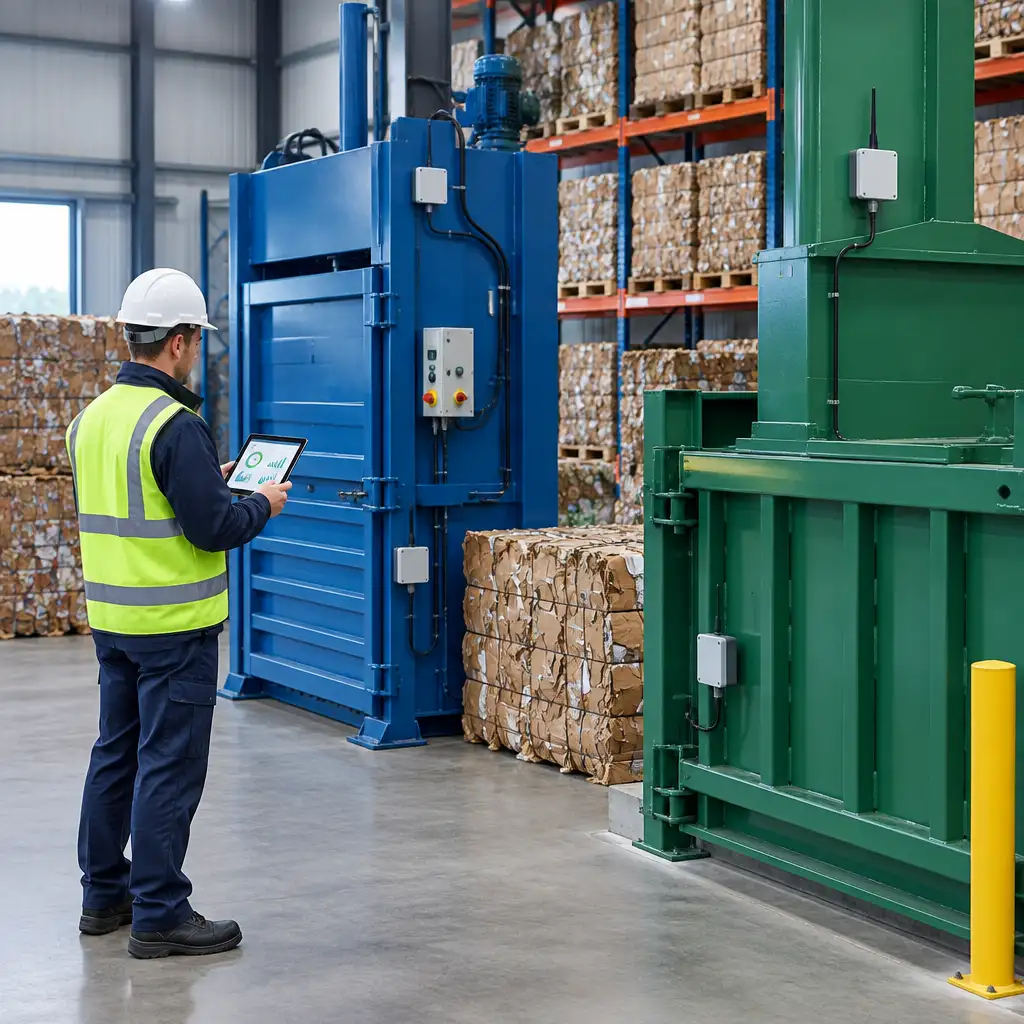
Many warehouses and distribution centres in Ireland are exploring ways to improve waste handling efficiency and reduce unexpected downtime. Retrofitting existing balers and compactors with sensors and basic Internet of Things (IoT) equipment is one pragmatic approach. This article looks specifically at the costs, expected savings, maintenance benefits and installation considerations relevant to Irish businesses that operate waste handling machinery.
We will explain common retrofit options, compare basic diagnostics with full telematics, offer estimated payback periods based on realistic Irish examples, and describe how retrofits change maintenance practice in ways that often prolong machine lifespan. The aim is practical guidance rather than hype — helping facilities managers and operations teams make informed decisions about Waste Handling Equipment Ireland.
Throughout the article we use real-world considerations for Irish warehouses: space constraints, typical waste streams (cardboard, plastic, general waste), and the service landscape in Ireland, including faster response times in Leinster and nationwide support. We also signpost relevant Baleforce services and equipment pages for readers who want assessment, servicing or new equipment options.
- Introduction
- Costs and typical retrofit costs
- Basic diagnostics vs full telematics
- Expected savings and payback periods
- Maintenance and preventative benefits
- Practical installation considerations for Irish warehouses
- Recommended retrofit partners and next steps
- Frequently Asked Questions
Costs and typical retrofit costs
Understanding the cost breakdown is essential for establishing a business case. A simple retrofit—fitting vibration or cycle-count sensors and a basic gateway—can cost in the region of €1,000 to €3,000 per machine, including hardware and basic installation labour. These systems typically provide run-time hours, cycle counts and simple alerts. More comprehensive sensor packs with load cells, door switches and environmental sensors increase that figure to €3,000–€6,000 per unit.
Full telematics packages that include cellular connectivity, GPS (for mobile compactor units), edge controllers, cloud subscriptions and integration with facility management systems can cost €6,000–€12,000 upfront, plus a monthly subscription of €10–€50 per machine. The subscription covers data hosting, dashboards, advanced alerts and sometimes analytics or integration support.
Other costs to budget for include control-panel integration, safety validation, and commissioning. For older machines this can mean additional control upgrades or minor hydraulic and electrical works to expose useful signals. Baleforce’s approach is to assess machines first to identify hidden work before quoting — this keeps unexpected costs to a minimum and follows the company principle of repair before replacement.
Basic diagnostics vs full telematics
Basic diagnostics generally means fitting sensors that monitor a small set of indicators: motor run hours, cycle counts, pressure or vibration thresholds, and door position switches. These systems are low-cost to install and simple to interpret. They are ideal where the priority is straightforward alerts to prevent misuse and to capture utilisation data for scheduling collections or operator training.
Full telematics systems expand the scope: continuous data capture, trend analysis, predictive alerts, integration with maintenance management software, and remote access to diagnostics. With full telematics you can detect gradual performance drift (for example falling compaction force or rising hydraulic operating temperature) and schedule interventions before failure. Full systems are more valuable for larger fleets or sites where downtime costs are high.
Choosing between the two depends on scale and objectives. For a single baler in a small warehouse, basic diagnostics provide quick wins at lower cost. For multi-site operations or high-throughput distribution centres, full telematics often unlocks greater savings through predictive maintenance and centralised fleet management. We recommend a site assessment to define the right level of investment for each facility.
Expected savings and payback periods
Typical savings come from reduced labour handling, fewer emergency call-outs, optimised collection schedules and longer equipment life. For Irish warehouses, common measurable savings include a reduction in unscheduled repairs (less overtime and call-outs), fewer service truck visits due to planned works, and lower waste contractor charges through better compaction efficiency.
As a rule of thumb, basic diagnostic retrofits often repay their initial cost within 9–24 months in a busy warehouse environment. This assumes measurable reductions such as a 20–40% fall in emergency repairs and modest improvements in collection efficiency. Full telematics packages, while more expensive upfront, tend to show payback periods of 12–36 months for medium to large operations because they enable predictive maintenance and centralised monitoring across multiple machines or sites.
Real-world example: a 30,000 sq. ft. distribution centre in Leinster retrofitted three compactors with load sensors and telematics. They reported one emergency repair avoided in the first year, a 30% drop in service call-outs and optimized contractor collections, producing a payback of around 18 months. Projected lifetime savings also included delayed capital replacement by two to three years through better maintenance planning.
Maintenance and preventative benefits
Sensors change the maintenance conversation from reactive to scheduled and, with full telematics, predictive. Instead of fixing a baler after failure, teams can plan hydraulic checks after a set number of cycles, replace seals before they fail, and address overheating or vibration trends early. This reduces associated collateral damage and prevents downtime during peak periods — a significant advantage for warehouses that operate continuous shifts.
Routine data such as cycle counts and motor run hours make it straightforward to create evidence-based maintenance intervals that replace guesswork. These intervals typically reduce parts consumption and extend component life. Baleforce’s maintenance contracts often use sensor data to refine service milestones, ensuring skilled technicians arrive with the correct parts and tools, reducing repeat visits.
Improved maintenance benefits safety and compliance too. Simple sensors that record door openings and interlock status help validate safe operation and operator training needs. When combined with operator training and regular servicing, the result is improved uptime, lower repair bills and a stronger safety record — important for internal compliance and insurance considerations.
Practical installation considerations for Irish warehouses
Site logistics matter. Sensor cabling, gateway placement for reliable cellular or Wi‑Fi connectivity, and safe routing of wiring around hydraulic and moving parts are key considerations. Older machines may need small control-panel modifications to expose signals for monitoring. These works should be performed by an experienced technician to preserve machine safety and warranty conditions.
Power and connectivity are often overlooked. Some sensors are battery-powered and wireless, simplifying installation, but gateways still require power and a reliable data link. Where cellular coverage is weak inside yards or warehouses, consider external antennas or local Wi‑Fi integration. Planning for connectivity early avoids costly rework after devices are installed.
Operational readiness is also important. Scheduling installation during low-activity windows minimises disruption. Baleforce offers machinery assessments and can advise on the most practical installation approach for your site, whether that is a minimalist diagnostic retrofit or a full telematics rollout that integrates with existing facility systems.
Recommended retrofit partners and next steps
When choosing retrofit partners, look for organisations with experience in both waste handling machinery and industrial sensor systems. Baleforce recommends a staged approach: start with a free machinery assessment to identify machine readiness, then pilot a small number of machines before committing to a fleet-wide roll-out. You can request a free machinery assessment via the Baleforce site to get started.
Equipment manufacturers such as Europress can offer factory-supported upgrades for newer machines and are a sensible partner when considering new purchases or OEM-compatible retrofits. For older third‑party machines, independent retrofit specialists who understand hydraulic controls and machine safety are preferable. Baleforce supports both Europress equipment and third-party machines and can advise on practical retrofit strategies.
For businesses considering replacement rather than retrofit, Baleforce’s equipment solutions pages outline new and refurbished options that might be more cost-effective for heavily worn machines. For many customers the decision framework is simple: repair first, upgrade where beneficial, replace only when justified. A short site assessment will indicate the most cost-effective path forward.
Frequently Asked Questions
Q: How much disruption will a retrofit cause on-site?
A: Most basic diagnostic retrofits can be completed within a day with minimal disruption if planned for low-activity periods. Full telematics installations may take longer due to control-panel work and connectivity setup; a site assessment will produce a clearer schedule.
Q: Will sensors void existing warranties or affect safety compliance?
A: Properly installed retrofits by competent technicians maintain safety compliance. For machines under OEM warranty, consult the manufacturer; Baleforce can coordinate with Europress or other manufacturers to ensure warranty-friendly upgrades where possible.
Q: Can sensor data be integrated with our maintenance software or facility management systems?
A: Yes. Many telematics packages offer APIs or integration options to feed data into maintenance management platforms. For simpler systems, CSV exports or dashboard access are common. Discuss your integration needs during the initial assessment.
Not sure whether your equipment should be repaired, upgraded, or replaced? Baleforce Ireland offers honest, practical advice backed by over 20 years of industry experience. We focus on helping customers make informed decisions based on safety, reliability, and long-term value. Contact us at 087 458 0610 or info@baleforceireland.ie to discuss your options.