
Introduction
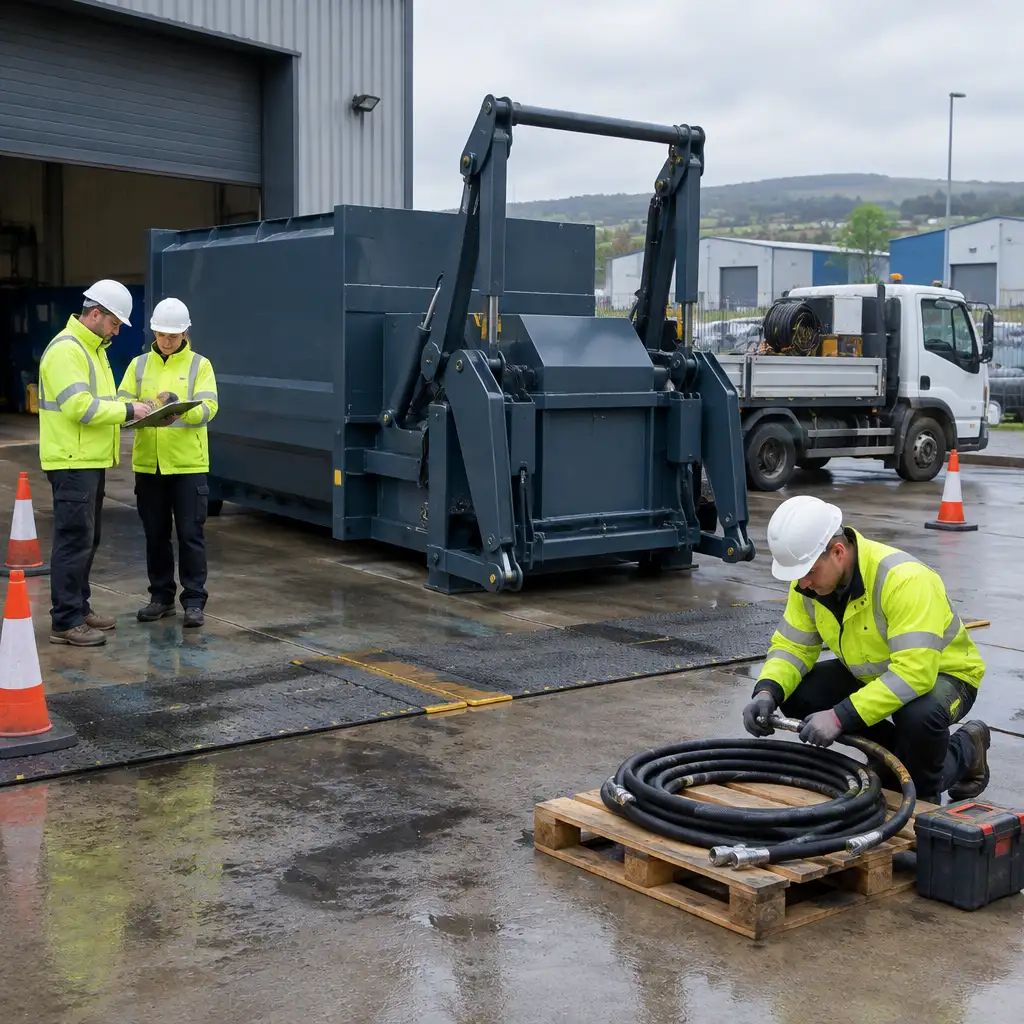
Planned, realistic breakdown drills for balers and compactors are one of the most effective ways for businesses in Ireland to reduce actual downtime and improve safety when equipment fails. This article explains why simulated breakdown exercises matter, how to design them, and how to measure outcomes so your site responds faster and smarter when a real fault occurs.
For facilities that rely on waste handling equipment—warehouses, retail centres, manufacturing plants and recycling facilities—an unexpected baler or compactor fault can disrupt operations, add costs and create safety risks. Running structured drills lets teams practise communication, contractor coordination and temporary workarounds so the real event causes minimal disruption.
We cover step-by-step planning, role assignments, use of hire equipment during drills, coordination with maintenance contractors, checklists for operators and supervisors, and how to update continuity plans based on drill results. Practical templates and references included will help managers and engineers implement repeatable exercises across Irish sites.
- Introduction
- Why simulate baler and compactor breakdowns?
- Planning a simulated breakdown exercise
- Roles and responsibilities: who does what
- Using hire equipment and coordinating maintenance contractors
- Drill checklists and step-by-step drill flow
- Measuring outcomes, updating continuity and maintenance plans
- Frequently asked questions
Why simulate baler and compactor breakdowns?
Simulation exposes weaknesses in a site’s response that are often invisible until the pressure of a real breakdown. Communication gaps, unclear contractor call‑out procedures, missing parts, or unfamiliarity with isolation and lock‑out procedures can be revealed. The purpose is not to create panic but to learn in a controlled way so that safety and continuity improve.
For organisations in Ireland, local factors such as regional contractor availability, traffic times for parts delivery, and shift patterns influence downtime. A simulated drill lets you test response times from internal teams and external partners, and it helps validate the assumptions in your continuity plans—especially the faster response window Baleforce Ireland offers across Leinster and nationwide coverage for the rest of the country.
Simulations also give technical teams a chance to practise safe fault diagnosis and temporary measures that allow operations to continue while awaiting repairs. This aligns with the practical principle of repair before replacement, helping sites make cost‑effective decisions during and after an incident.
Planning a simulated breakdown exercise
Start with clear objectives: what do you want to validate? Common aims include testing emergency contact procedures, measuring time to safe isolation, confirming quick temporary throughput options and rehearsing contractor mobilisation. Define success metrics up front—response time, time to safe isolation, alternative waste handling capacity, and accurate incident logging.
Next, choose the scenario. Scenarios should be realistic and relevant: an electrical control failure on a baler, a hydraulic leak on a compactor, a sensor fault that causes unexpected stops, or a complete power loss. Tailor the complexity to the team: a basic drill for operator teams and a full scenario involving site management, contractors and logistics for senior staff. Document the scenario in a short script so observers know what to watch for.
Make practical arrangements well ahead of the drill: pick dates with minimal disruption, notify safety teams and staff, and secure permission for any restricted actions. If the drill will involve contractor attendance or temporary hire equipment, confirm availability and costs. Consider running a tabletop version before the live drill to iron out ambiguities and avoid unnecessary operational risks.
Roles and responsibilities: who does what
Assign clear roles before the drill. Typical roles include the Site Incident Lead, Operations Liaison, Safety Officer, Technical Lead (on-site technician), Communications Lead and an external Contractor Liaison. Each role should have a short written brief describing tasks to complete during the drill—who to call, what to record, and what decisions they are authorised to make.
Operators must practise safe isolation, lock‑out/tag‑out and basic troubleshooting steps. The Technical Lead should document diagnostic steps and estimated repair options. The Communications Lead should simulate notifications to senior management, suppliers and customers where relevant. Observers—who do not take part in the actions—should record timestamps and note where procedures were unclear or where additional training is needed.
When external maintenance contractors attend, ensure the Contractor Liaison provides necessary site inductions, safety information and a clear briefing on the scenario. This avoids wasted time and keeps health and safety compliance central to the exercise. If you do not already have a maintenance relationship, consider using Baleforce Ireland’s breakdown and emergency repairs service or request a machinery assessment so you have a reliable partner for real events.
Using hire equipment and coordinating maintenance contractors
Using hire equipment during drills replicates a real continuity option: bringing in a temporary compactor or baler to maintain throughput while repairs proceed. Include hire logistics in the plan—lead time for delivery, site access, power and mounting requirements, and any operator training the hire company can provide. Treat the hire unit as you would a permanent piece of equipment for the duration of the drill, with safety checks before use.
Coordinate closely with maintenance contractors. Confirm contact numbers, expected response windows and escalation procedures. A good contractor will share a realistic assessment of repair options: temporary fixes to restore operation, parts lead times, and recommendations for repair versus replacement. For urgent situations, your contractor should be able to support emergency baler repairs or emergency compactor repairs and provide clear next steps to reduce downtime.
Document contractor performance during the drill. Note arrival times, effectiveness of their diagnostics, quality of temporary fixes and clarity of communication. These observations feed back into supplier evaluations and procurement decisions—whether to keep a preferred contractor on retainer, add a local hire option, or review maintenance contract terms.
Drill checklists and step-by-step drill flow
Use checklists to ensure drills follow a safe, reproducible flow. A basic checklist items list should include: pre-drill safety brief, confirm scope and objectives, communication chain, isolation procedure verification, diagnostic steps, contractor call‑out, temporary hire deployment, and post-drill review. Put a time allowance beside each step so observers can record actual durations.
Example drill flow: 1) Incident declared by operator; 2) Site Incident Lead notified and safety isolation carried out; 3) Technical Lead runs initial diagnostics and documents fault; 4) Contractor Liaison contacts maintenance contractor and confirms ETA; 5) Communications Lead issues internal notices and customer contingency updates if required; 6) Hire equipment is arranged and set up as needed; 7) Observers record timestamps and compliance items; 8) Post‑drill debrief and action log compiled.
Make sure the drill tests both technical actions and human factors: clarity of instructions, decision points, and who can approve temporary measures. Keep records of all timings, decisions and recommendations to populate an action register that feeds into maintenance plans, operator training and procurement decisions for used or new equipment solutions where appropriate.
Measuring outcomes, updating continuity and maintenance plans
Define measurable outcomes before the drill and capture them with timestamps and observer notes. Useful metrics include time to safe isolation, time to contact the contractor, contractor arrival time, time to identify a temporary workaround, time to return to restricted operation and full recovery time. Record where processes slowed down or where essential parts or skills were unavailable.
Use the drill findings to update continuity plans and maintenance strategies. If drills show frequent delays due to parts availability, add critical spares to site inventory or arrange quicker parts access through suppliers. If contractor response falls short, review service agreements or establish relationships with alternative providers. Baleforce Ireland provides machinery assessments and a range of servicing and repair options that can be referenced when choosing long-term support arrangements.
Drills also inform preventative maintenance schedules. If a scenario reveals common faults—worn seals, leaking hydraulics, or recurring sensor faults—adjust inspection routines, update operator walkaround checks, and consider upgrades or retrofits for reliability. Regularly scheduled drills, combined with robust servicing, reduce the frequency and impact of real breakdowns and align with the principle of repair before replacement.
Frequently asked questions
Q: How often should we run simulated breakdown drills for balers and compactors?
A: Aim for at least one full-scale drill annually and smaller tabletop exercises every six months. High-throughput or high-risk sites may benefit from quarterly practical drills. Frequency depends on turnover, staffing changes and previous incident history.
Q: Can we use hire equipment to keep operations running during a real breakdown?
A: Yes. Temporary hire compactors or balers are a practical continuity option. Plan for delivery lead times and ensure your team is briefed on safe operation. Include hire logistics in drills to validate timings and practical issues.
Q: Who should we contact for emergency technical support and realistic repair estimates?
A: Use an experienced service partner with national coverage and proven response times. For sites in Leinster, faster on‑site response is often available. Baleforce Ireland provides breakdown and emergency repairs, machinery servicing and free machinery assessments to help decide repair versus replacement.
Need support with waste handling equipment anywhere in Ireland? Baleforce Ireland provides nationwide service, repairs, machinery assessments, upgrades, operator training, and technical support, with faster response times throughout Leinster. Call 087 458 0610 or email info@baleforceireland.ie to get started.